Showing posts with label Courses. Show all posts

Monday, 19 October 2015

Choosing BIO-ENGINEERING


What Is Bioengineering?

Exact definitions of bioengineering can differ slightly. Most academics would agree that bioengineering involves using the principles of engineering to develop solutions for health-related products and techniques that improve the quality of life. But from there, it can take off in slightly different directions, depending on the focus of a specific program or research project.

The National Institutes of Health defines bioengineering as "the application of the life sciences, mathematics and engineering principles to define and solve problems in biology, medicine, healthcare, and other fields." Some practitioners want to apply bioengineering to any engineering discipline that works with a living system. That would include humans, plants, and even microscopic organisms, in addition to some aspects of agricultural engineering and national defense.

A few degree programs use the term "biomedical engineering" synonymously with bioengineering. Other schools' biomedical engineering programs emphasize applications in medicine and health care, and reserve "bioengineering" to emphasize non-medical applications, such as artificial intelligence or agricultural engineering. The term bioengineering will be used broadly here, but when considering colleges, it is important to research just what each school means by the term and what each program offers.

Despite differences in terminology and focus, bioengineering is a rapidly growing academic discipline across the United States. Student demand has led many universities to add programs at the undergraduate, master's and Ph.D. levels. These new engineering degree offerings have drawn many working professionals and medical practitioners back to school, often part-time or online, so they can stay current in the profession and get ahead in their careers. For experienced engineers who have already mastered the hands-on aspects of training, online degrees in bioengineering allow them to further their careers without sacrificing continued experience.

Although bioengineering may encompass many areas, one of its primary functions is to develop better solutions for the prevention, diagnosis, and treatment of disease; patient rehabilitation; and to improve health.
Biomedical Engineering

Bioengineering has been vital in developing:
  • Artificial hips, knees and other joints
  • Ultrasound, MRI and other medical imaging techniques
  • Engineered organisms for chemical and pharmaceutical manufacturing
  • Pacemakers, dialysis machines, and diagnostic equipment

What Does a Bioengineering Major Do?

Because bioengineering combines the two major disciplines of biology and engineering, bioengineers have a wide variety of career choices. Some graduates may work alongside medical practitioners, developing new medical techniques, medical devices, and instrumentation for manufacturing companies. Hospitals and clinics employ clinical engineers to maintain and improve the technological support systems used for patient care. Graduates with advanced bioengineering degrees perform biological and medical research in educational and governmental research laboratories.


Bioengineering often applies traditional engineering expertise to human applications in medicine. Many bioengineering professionals seek to help people by solving complex problems in medicine and healthcare. Some bioengineering jobs combine several disciplines, requiring a diverse array of skills. Digital hearing aids, implantable defibrillators, artificial heart valves, and pacemakers are all bioengineering products that help people combat disease and disability. Bioengineers develop advanced therapeutic and surgical devices, such as a laser system for eye surgery and a device that regulates automated delivery of insulin.

Bioengineering techniques have led to major scientific breakthroughs, such as:
  • Ultrasound
  • Computer-assisted tomography
  • Magnetic resonance imaging
  • Other medical imaging systems
Bioengineers conduct research in many areas. In genetics, for example, engineers try to detect, prevent, and treat genetic diseases. Sports medicine bioengineers develop rehabilitation and external support devices. Medical research bioengineering specialists also examine rehabilitation and assisted living techniques. In industry, bioengineers conduct research and create designs for a more in-depth understanding of living systems and technology. Government researchers often work in product testing and safety, where they establish safety standards for medical devices. A biomedical engineer employed in a hospital might advise on the selection and use of medical equipment or supervise performance testing and maintenance.

Bioengineers design artificial joints, tissues and organs. They create artificial devices that substitute for missing body parts, including hearing aids, cardiac pacemakers, artificial kidneys and hearts, blood oxygenators, synthetic blood vessels, joints, arms, and legs. The devices used by medical professionals to diagnose and treat ailments are designed by bioengineers. Some examples of these innovative tools are the computers that analyze blood, the laser systems used during corrective eye surgeries, and medical imaging devices such as MRI and CT scanners.

Bioengineering is not confined to designing and producing medical devices. It can include any situation in which technology interacts with a living system. Because the discipline encompasses a broad range of knowledge, it is vital that bioengineers be mentally flexible. They must be willing to experiment with techniques from other industries and to work with people from other disciplines. Developing a kidney machine, for example, requires combining several different engineering specialties. It incorporates water treatment and purification, heating and temperature control, measurement systems for flow and pressure, electrolytes, alarm systems for monitoring vital signs, data collection and processing, ergonomics, and electrical safety.


Career Education in Bioengineering

A core college curriculum in bioengineering will be heavy in math, physics, chemistry and biology. Other courses that will help include computer science and communication classes that emphasize verbal skills. Bioengineering involves a great deal of interaction with other professionals and that requires communicating effectively.

Preparation for bioengineering is similar to any other engineering discipline--except life science courses should also be included. When available, advanced placement courses in these areas are beneficial. At the college level, the most common option is to earn an engineering degree with a specialization in bioengineering.

College degrees in bioengineering often emphasize particular aspects of the biomedical industries, such as prosthetic devices or medical instrumentation; other programs emphasize bioengineering as a pre-med major. Courses in chemical, electrical, or mechanical engineering constitute a major portion of the curriculum for many programs.

Many students earn their college degrees in a different engineering specialty and then move into bioengineering for a master's degree or doctorate. Most graduate-level programs look for students who have a background in engineering or science. Typically, a graduate program will seek students with some mix of coursework in calculus, physics, chemistry, and biology. Bioengineering must be studied in a lab, but many of these preparatory college degrees may be earned online by busy working adults.

Is an Advanced Degree Necessary for a Bioengineering Career?

Although many engineering specialties do not require a graduate degree, it is typically recommended or even required for entry-level jobs in bioengineering. The combination of knowledge in biology and engineering is often more than can be mastered in a single undergraduate program. A master's degree is preferred. Doctorates are more typical for those who want to advance into research, especially at a university.

Survey results have repeatedly confirmed that almost a third of graduates obtaining a B.S. in bioengineering go on to medical school, a third go on to graduate school, and a third go straight into the workforce.

What Can You Do With a College Degree in Bioengineering?

Because bioengineering is such a broad discipline, preparing students for a bioengineering degree is a challenge for any program. Becoming a good engineer is the first prerequisite for a career in bioengineering. After that, students should acquire a working knowledge of the life sciences.

Some students will have an opportunity to major in bioengineering. Others may combine on-campus or online engineering degrees with additional biology classes. If a bioengineering specialty is not available at your college, you still have an opportunity to obtain a master's degree in bioengineering elsewhere. Graduates should be able to demonstrate well-defined engineering skills that apply to the biomedical field when entering the job market. This can include a major project or practical experience through work or an internship.

Bioengineers generally have their choice of jobs in hospitals, universities, industry, or research laboratories. They're employed by medical device manufacturers, pharmaceutical companies, regulatory agencies and medical research institutions. Bioengineering graduates are often qualified to pursue advanced study for careers in medicine, law, business, education, and other fields. As technology advances, new jobs and fields of research are constantly appearing. Computer-assisted surgery, for example, as well as molecular, cellular, and tissue engineering, are developing rapidly. Rehabilitation and orthopedic engineering specialties also are growing quickly.

The Biomedical Engineering Society has developed a list of some specialty areas in bioengineering, including:
  • Bioinstrumentation, which applies electronics and measurement techniques to create devices used in diagnosis and treatment of disease.
  • Biomaterials, involving living tissue and artificial materials that are implanted in individuals. This specialty requires a deep understanding of living material.
  • Classical mechanics, such as statics, dynamics, fluids, solids, thermodynamics, and continuum mechanics, which are applied to solve medical problems through biomechanics. Developments in this area have led to the artificial heart and valves, artificial joint replacements, bone cartilage, and tendons of the musculoskeletal system.
  • Cellular, tissue and genetic engineering, using the anatomy, biochemistry and mechanics of cellular and sub-cellular structures to attack biomedical problems at the microscopic level.
  • Clinical engineering, involving the development and maintenance of computer databases of medical instrumentation and equipment records. Clinical engineers often work with physicians to develop instrumentation that applies the latest technology to a specific healthcare system.
  • Medical imaging, which generates an image for physicians that can be used in diagnosis or patient treatment.
  • Orthopedic bioengineering, examining the friction, lubrication and wear characteristics of natural and artificial joints. Orthopedic engineers perform stress analysis of the musculoskeletal system, and develop artificial biomaterials for replacement.
  • Rehabilitation engineering, a growing specialty whose function is to enhance the capabilities and improve the quality of life for people with physical and cognitive impairments. This niche includes prosthetics, the development of home, workplace and transportation modifications, and the design of technology to enhance seating, positioning, mobility, and communication.
  • Systems physiology, involving the engineering strategies, techniques, and tools needed to understand the function of all living organisms, from bacteria to humans.
  • Consulting. This career choice is particularly inviting for someone who prefers variety in work assignments. Besides solid credentials in the field, consulting also requires some business and entrepreneurial expertise and substantial communication skills.
  • Teaching. The growing number of bioengineering degree programs has increased the need for college-level instructors. Teaching bioengineering at the university level, however, is likely to require a doctoral degree along with professional experience.

Bioengineering Career Trends

The U.S. Bureau of Labor Statistics (BLS) counted about 20,080 biomedical engineering jobs in 2014, and projected a 27 percent increase in positions through 2022, much faster than the average for all occupations. Most bioengineering specialists work in medical equipment and supply manufacturing, scientific research and development services and pharmaceutical and medicine manufacturing. Many others work for hospitals, government agencies, or as independent contractors or consultants.
An aging population, focused on health and quality of life issues, has increased the demand for better medical devices and equipment. Coupled with this long-term trend is an industrial concern for cost efficiency and effectiveness. This requires the talent of biomedical engineers.


Universities across the United States are adding bioengineering to their curricula as a separate department or as an engineering specialty. The growing interest in this field has increased the number of degrees granted in biomedical engineering. Students who do not begin their bioengineering degree programs soon will likely face stiffer competition for jobs, despite the growth in this field.

Tuesday, 13 October 2015

11 things to know before Choosing ARCHITECTURE

1

Drink tea not coffee. Coffee is great for a sudden burst of energy propping you up during late nights on CAD but beware! The caffeine in coffee gets into your blood quickly giving you an initial rush that, if sustained, will cause your body to burn out. A strong mug of tea has a similar amount of caffeine but it’s released more gradually keeping you focused but calm for longer. Tea is also an antioxidant, relieves tension and is less of a faff to make.
pinterest.com

2

Draw lots and draw by hand. Drawing isn’t just a way of communicating with others it’s a way of thinking. From Le Corbusier’s messy sketches to Zaha Hadid’s vast paintings, drawing is essential to the practice, culture and progress of architecture.
le_corbusier

3

When making models use a sharp scalpel. Scalpel blades are not cheap when bought from craft shops and blunt quickly but don’t be tempted to cut your costs by using dull blades. If you slip and cut yourself a blunt blade will give you a messy and painful wound that takes ages to heal. However, if you cut yourself with a fresh blade the wound will be cleaner, will heal faster and if serious will be easier for a medic to dress. You can save money buying scalpel blades online in bulk.
will_pomroy_scalpel

4

Pin-up straight. Sounds like a no brainer but it is amazing how many first year pin-ups lead to hastily taping drawings to walls wonkily. Even a rough sketch on torn butter paper deserves better than that. Invest in a huge box of pins and line up your drawings with each other as well as the wall.
crit_selection_22032013_73

5

Your tutors are an invaluable source of wisdom and ideas – use them lots. Don’t just wait for your weekly tutorial to roll around; actively seek out the advice, opinions and critique of your school’s faculty. Knock on their doors, email them, chase them through hallways, lie in wait near their office. Do whatever it takes.
ad_interior_architecture_ad_ia_studio_web_16.jpg

6

Your tutors’ knowledge only goes so far. Intelligence, experience and damning criticisms they may have, a monopoly on the truth they do not. Sometimes the best tutor is the one who tells you to design the blue house so you become even more determined to design the red one. Listen carefully and understand their point of view but take what your tutors say with a pinch of salt.

7

Power nap with caution. By the end of your time at architecture school your friends will have experimented with every sleeping cycle under the sun. Some will swear that 20 minutes sleep is more refreshing than 40. Others will switch to sleeping in four-hour bursts alone. You’ll see students making beds beneath their desks in studio or going 80 hours without sleep. There may well be times when you have to work late but the truth is that you’re never going to produce great work when knackered – far better to stay focused and productive during normal working hours than to let your course steal your sleep and productivity. Keep a regular daily timetable. Give yourself firm finishing times in the evening and stick to them.
studio_nl_desk_bed_1_650x435

8

Subscribe to a journal. Regularly reading an architecture magazine is an invaluable source of inspiration. A good journal should challenge you to think deeply about architecture and its relationship to the wider world but should also be a thoroughly good read and beautifully designed. From a tutor’s point of view the difference between students who are regularly reading articles or short essays in architectural journals and those who are not is dramatic. Luckily many architecture journals have great student deals on at the moment if you can find them. The Architectural Review is just £1 a week for students.
AR Cover

9

University grading systems are odd and architecture marking is brutal. Students who’ve been at the top of their class all their lives arrive at architecture school and find themselves struggling to get middle-of-the-road marks. Take heart. Your final grade is far less important than the skills and portfolio you’ll build on your way to it. The line up of internationally acclaimed architects is littered with designers who did badly at architecture school, dropped out or didn’t study architecture at all.
architecture_crit_quote

10

Eat delicious food. With so many deadlines it can be tempting to buy ready meals and takeaways rather than waste time cooking. This is a false economy. A good diet gives you more energy through the day, keeps you healthy and prepares you for a life of wearing slinky black turtlenecks. If you’re not the next Bompas and Parr already learn to cook some simple meals in large quantities that will keep for a few days – soups, stews, pastas and pastries.
a6f1c00c2709cb35ba3061aa3eee953c

11

Explore. Travel often with an open mind. Understand cultures and traditions different to your own. That doesn’t necessarily mean jet setting around the world or hitchhiking to Morocco. Wherever you are based there will be a myriad of unfamiliar communities and landscapes within easy reach. Get to know the country you are studying in better – even if you grew up there.
fbfb74746dad2b5acb5142f0bc807e2e

Sunday, 11 October 2015

Choosing INDUSTRIAL PHYSICS


What Is Physics?

Briefly defined, physics is the science that tries to understand the laws of nature and the relationship between energy and matter. However, it might be more appropriate to define physics as a way of thinking rather than as a profession. The field of physics trains students to take a logical, problem-solving approach in whatever situations they might find themselves. Physics students explore concepts and methods of science that can be applied in many different professional areas and research topics.
Physics deals with everything from subatomic particles to black holes and the overall structure of the universe. Physicists use mathematical formulas to try to explain their theories and make predictions. It is a science that has attracted and confounded some of the most brilliant minds of all time: Sir Isaac Newton, Albert Einstein, and Stephen Hawking, to name just a few.

But physics is also concerned with how things work on a more tangible level. The laws of physics are applied to fields such as engineering, communications, biology, and electronics. The development of technologies like lasers and semiconductors resulted from pioneering work in physics. Televisions, microwaves and digital cameras would not exist without breakthroughs in physics.

Physics is really the study of how the world works, and, it might be considered the most fundamental of all the sciences. The goal of physics is to develop theories that will summarize the laws of nature and lead to an understanding of why things work as they do. The basics of physics can be applied to most other sciences, and for that reason, a great many people use physics as a springboard into other fields of study or professions.

Math Science

What Does a Physics Professional Do?

Nearly 90 percent of all "physicists" are working in medicine, education, industry, or other professions. Physicists are in demand for their analytical skills in many financial, fund management and research roles, in law, as weather forecasters, computer programmers and as physics and science teachers.
Job descriptions are difficult to quantify in this field. The physicist might work in a laboratory, designing materials for computer chips or smashing atomic particles. Physicists have orbited the Earth and explored the oceans. They also build instruments that diagnose disease; they develop better and more efficient fuels for cars and homes; they calculate the movement of Arctic glaciers, and they create smaller, faster electronic components for computers.

Some physicists in research and development, especially those employed at universities, help increase our overall scientific knowledge. More often, they conduct research for government agencies or for private sector companies to develop new devices for the marketplace. They also design equipment or find new uses for older technology.

Medical physicists have greatly enhanced the well being of patients through the application of physics. Such advances as computer tomography, laser treatments for cancer, and the X-ray have improved health care over the years and led to more effective diagnosis and treatment of medical ailments.

Those professionals who do actually become physicists most often work regular hours in a laboratory where they plan and conduct experiments, build models for study, and examine test results. But this work can extend beyond the laboratory. Often, physicists must report on their results in lectures or through academic papers. They also might be responsible for finding the grant money that funds their work. These efforts require extensive skills in oral and written communications.

Job openings in universities and industry are increasing, thanks partly to a wave of retirements by senior physicists who entered the job market in the early 1960s. However, growth in academic jobs for physicists is expected to remain slower than average. Physics majors will continue to be in strong demand in industry, especially in the areas of information technology and semiconductor technology.
Physics graduates tend to split evenly between the workforce and graduate school. More than half of those students who return to graduate school decide to major in physics or astronomy. After those, the most popular graduate programs are in engineering, math, medicine, law, and education. Just over a quarter of all physics graduates who earn a bachelor's degree go to work in the private sector. Other career options include high school teaching, government, and the military.


For High School Students: Preparing for Your Career Education in Physics

Anyone planning to study physics in college should prepare at the high school level with a curriculum that is heavy in algebra classes, with some calculus and trigonometry where possible. Math skills are essential, but science classes are an important part of preparing, too.
Students who plan to use physics as a launch pad into another career should consider the types of classes that will be appropriate for their long-term objectives. For instance, English literature classes combined with writing and public speaking classes are helpful for nearly any career. Business management, economics, or accounting classes will be useful for scientists who want to compete in the business world.

Education counselors also recommend that students get more familiar with the applications of physics by reading common introductory works. Some recommended books are "The Elegant Universe" by Brian Greene, "A Brief History of Time" by Stephen Hawking, and "Flying Circus of Physics" by Jearl Walker.

Take advantage of any opportunity to get involved in extracurricular activities and expose yourself to as much science as possible. Science fairs are an excellent way to gain practical experience. Admissions counselors prefer to recruit students who demonstrate leadership abilities by volunteering to head up school clubs. Leadership qualities are even more important for students who want to go on to graduate school.

Find adults who have experience or an interest in physics, including your teachers. Having a mentor to talk to about physics or ask questions plays an important role in your professional development. Get to know your teachers and professors.

Is an Advanced Degree Needed to Work in Physics?

Nearly a third of physics students choose to double-major, with math being the most common focus. This is usually because only a few extra classes beyond those required for the physics degree are needed for the additional math degree. But math is not the only option. Some of the other most common double majors are science degree programs such as computer science, astronomy, and chemistry. Education degrees and teaching certifications are required for aspiring science or physics instructors.
Some schools have two options in their bachelor's degree programs. One prepares the student who wants to get a graduate degree and become a theoretical physicist. The other is for those who just want to develop essential skills to enter another career. A bachelor's degree is typically the only requirement for the latter option.

A master's degree or doctorate is required for teaching university-level physics, or for top-level research in private industry or in government labs. Most professionals who go into this type of research have doctorates. Graduate degrees require concentrated study in a particular area of the student's choosing. Online physics degrees have become more popular among working professionals who are ready to further their educational credentials. In an online physics degree, topics of study might include beam physics, health physics, radiation biology, and physics education.

Graduates with bachelor's degrees have reported that people skills are an essential part of their work activities. Much of their time is spent on activities that have nothing to do with science, such as teamwork, dealing with clients, managing projects, technical writing, making presentations, and training people. The physics major who has not mastered communication skills will be ill-prepared for the job market.


What Can You Do With a College Degree in Physics?

The answer most appropriate for this question is: anything she wants to do. However, while some physics majors go on to become professional physicists, the majority pursue careers in fields where they can put their knowledge to more practical applications. With their skills in problem-solving, mathematical reasoning, computer programming, and organizing and interpreting scientific data, physics grads can move into government and industrial jobs that require an ability to think logically and creatively. Physics majors are well-suited to jobs that require step-by-step problem solving using math skills and good observational and communication skills.
A wide range of industries seeks physics graduates: telecommunications, industrial physics, hospital physics, electronics, computing, quality control testing, banking, insurance, teaching, management, technical sales and the armed forces, for starters. Students who become physicists tend to specialize in one or more areas of physics, such as:

  • Nuclear physics. Nuclear physics involves the study of the components, structure, and behavior of the nucleus of the atom. It has a number of practical applications in developing nuclear energy, archeological dating, smoke detectors and nuclear medicine. Nuclear diagnostic techniques have revolutionized medicine by providing ways to "see" inside the body without surgery.
  • Geophysics. Geophysicists apply physical theories and measurements to discover the properties of the earth. Geophysics includes the branches of seismology, geothermometry (heating of the earth), hydrology (ground and surface water), and gravity and geodesy (the earth's gravitational field). Some of its applications are used in building highways and bridges, studying earthquakes, urban planning and archaeology.
  • Atomic, molecular and optical physics. In this field, physicists study matter and light interactions at the level of the atom. The three are usually grouped together because of their interrelationships, the similarity in methods used, and their related energy scales. Atomic physics is more concerned with the study of the atom than with the forces studied in nuclear physics. Molecular physics focuses on multi-atomic structures and their internal and external interactions with matter and light. Optical physics manipulates light to gain insight into the fundamental properties of light.
  • Astronomy. Astronomy is considered a subfield of physics. Astronomers observe and collect data used to explain relationships between stars and planets as well as other phenomena occurring in the universe. Astronomers, in conjunction with other types of physicists, might be called upon to solve problems connected with space flight navigation and satellite communications.
  • Astrophysics. Astrophysics is the part of astronomy that deals with the physics of stars, star systems and interstellar material. Astrophysicists apply the laws of physics to understand how astronomical bodies are formed, how they interact, and how they die. Astrophysics might be used to figure out how to get to other planets, how to build things in new and safer ways, or to examine how the human body adapts to new situations.
  • Space physics. Space physics is the study of the space environment from the uppermost reaches of the earth's atmosphere to deep space, especially the environment in which satellites must survive. It has important applications as society becomes increasingly dependent on satellites for communication, broadcast, weather monitoring, remote sensing, positional information and military uses. Space exploration has led to the creation of several products such as new types of ceramics, high-performance materials, and even microwave ovens.
  • Physics Education. Physics grads with bachelor's degrees can become elementary or high school teachers. There is almost always a shortage of teachers in the sciences. Technical schools will also hire physics majors who have some professional experience. Public schools require a certification to teach, but not all private schools or technical schools do.
  • Engineering Physics. Engineering is another outlet for the physics major. It is one of the most demanding professions, because it often deals with decisions that affect the safety of individuals. Building bridges, skyscrapers, airplanes, and electrical systems requires a solid foundation in physics. Some students will earn a degree in physics and then go on to graduate school for a master's degree in engineering. Others will double-major in physics and engineering. A few other industries that require a solid physics background are construction, chemical, food, aerospace, agriculture, energy, fuel, metallurgy, textiles and clothing, computers and transportation.
  • Computer Science. Computer science offers careers for the physics major in graphics and software, artificial intelligence, data processing and computer games. Computer hardware is the result of applied physics.
A student with an interest in physics and communications might consider telecommunications, television, image analysis, video recording, photography, laser technology, journalism, scientific writing and publishing. Other non-technical careers in which physics majors have found success are law, business administration, sports, marketing and business management.
Besides astronomy, space and earth science careers for physics majors include space technology, atmospheric sciences, energy and resources and ocean sciences. Openings in environmental sciences and physics would include positions studying noise control, pollution control, conservation, radiation protection, and environmental monitoring.

Despite the important and intriguing specialties available to physicists, the vast majority of physics majors enter other professions. They may teach high school physics, perform research and development in private industry or in government labs, or lend their expertise to medical imaging, scientific book publishing, and scientific reporting. Physics careers can come from unexpected places. Insurance companies, for example, hire physicists to study the performances of the products they insure and make recommendations for reducing injuries and property loss.

A graduate with a master's degree in physics can do most of the above jobs but usually with a higher degree of responsibility and pay. They also have the opportunity to teach at community colleges. A PhD holder is more likely to become a university professor or researcher. Industries will also hire PhDs to oversee research projects for their companies and design new scientific instruments.

Planning for Your Physics Career

Physics is not a career for the dilettante. People considering a career in this demanding but rewarding profession should first ask themselves whether they are excited by physics, above and beyond other options, and whether they are good at it. This profession requires a strong commitment of time and effort. For those who want to succeed, the rewards can be plentiful, but the preparation depends on the direction in which one wants to go.
The student who plans to build a career as a physicist must make academic requirements his first priority. That means paying attention to grades, especially in math and science classes, and scoring high on the Graduate Record Exam (GRE) in preparation for graduate school. In addition, future physicists must build relationships with faculty members who can provide letters of recommendation. Courses in the major are more important than courses in other disciplines, because applications to graduate schools will be based more on those grades. However, academic advisers recommend building communication skills with writing, literature and speech communication courses.

If you want a career in government or industry, communication and interpersonal skills rate higher than physics or math grades. Much of your time will be spent writing and making presentations. Computer skills and courses in areas such as statistics, electronics, and applied physics are important, too. When interviewing with potential employers, you must be able to show you are a team player.

Those students who want to teach in high school should be aware that they will need a teaching certificate to teach in public schools. Courses in education are important, as are communication and interpersonal skills. You will improve your chances of being hired if you are also qualified to teach classes such as biology, general science, or math.

Financial companies like the skills and critical thinking abilities of physics majors. Anyone considering a career in this industry should take classes in statistics, accounting and economics. Banks, insurance companies and investment firms are interested in math and science majors.

Students who want to apply to a medical or dental school should speak with a premedical adviser early in their college careers to determine the supplemental courses such as biology and chemistry that will be needed for acceptance to medical school. A premed student is required to take about the same amount of class work in physics as in biology, and about one-quarter of the knowledge needed for a medical school entrance exam is based on physics.


Overview
Physicists in industry have contributed immeasurably to the technological superiority which the United States has enjoyed for many years. More recently, economic pressures have prompted American industry to place increasing emphasis on specific technical and communication skills in their selection of personnel. We believe that the unique quantitative analytic skills and creating thinking abilities which are acquired through a rigorous physics education prepare an individual well for a career in industry. In order to enhance these skills, we now offer a postgraduate degree program in Applied & Industrial Physics.
The Applied & Industrial Physics option in the Physics Department at Virginia Tech leads to a degree of Master of Science in Physics and prepares a student to apply broad physics principles to technological problems of interest to industry. The program combines courses with applied and technological relevance with a research project that is carried out either in an industrial laboratory or on campus.
 
Optics research in Robeson Hall.
Additional emphasis will be placed on enhancing the communication skills of the student and on preparing the student to work with a team. The requirements for the degree include a research project leading to a project report or written thesis and the successful completion of a program of study. Courses in physics, chemistry, materials science, engineering, and business may be combined to satisfy the course requirements for the degree. The program can be completed in four semesters.

Program
Each student accepted into the Applied and Industrial Physics program will be assigned an interim advisor to plan an initial program of study. During the first semester, the student will select a thesis advisor and committee. In consultation with his/her advisor and committee, the student will define and plan the full program of coursework and research tailored to his or her specific interests and goals.
A minimum of 30 credit hours of coursework and research is required. At least twelve (12) of these hours must be courses in Physics, with the remainder in fields relevant to a career in industry. A minimum of six (6) hours and a maximum of ten (10) hours of research is required during the course of the program. This requirement may be satisfied by an industrial internship or by a research project on campus. In either case, the project is arranged in cooperation with a faculty advisor. When the student works at an industrial site, the company, in consultation with the student and student advisor, will designate a supervisor for the student. The student, thesis advisor, and industrial supervisor will meet at regular intervals to discuss the student's progress.
A project report on the research project must be submitted at the completion of the program.
The entire program is designed to be completed in two years; extension beyond this period requires the approval of the student's advisory committee. Special arrangements are possible for persons currently employed in industry who wish to enroll on a part-time basis.

Certification, Licensure, and Associations

No licensing is required for physicists, but anyone who plans to teach at a public elementary school or high school must receive a teaching certificate.
Professional Associations

Tuesday, 29 September 2015

Choosing INDUSTRIAL ENGINEERING


What Is Industrial Engineering?

Industrial engineering, in its current form, began in the early 20th century, when the first engineers began to apply scientific theory to manufacturing. Factory owners labeled their new specialists 'industrial' or management engineers.

Industrial engineering is commonly defined as the integration of machines, staff, production materials, money, and scientific methods. While many current industrial engineers still deal in these areas, the scope of their work has become more general. Today's industrial engineers work in many more settings than just factories; in recent years, fields like energy and IT have become particularly reliant on the skills of industrial engineers. These flexible professionals may also be employed in:
  • Hospitals and other health-care operations
  • Transportation
  • Food processing
  • Media
  • Banking
  • Utilities
  • Local, regional and national governments
The requirements for a college degree in industrial engineering are very diverse and, compared to otherengineering degree disciplines, very people-oriented. Budding industrial engineers learn to plan, design and implement complex systems for a given industry. They do this by taking into account every conceivable variable, from budgets to machine capabilities to human imagination and error. Online degree programs in industrial engineering are increasingly available to working engineers who want to advance their careers without sacrificing valuable income and work experience by attending school full-time.

In a nutshell, industrial engineering majors learn to use engineering and scientific principles to design, manufacture, or improve systems that involve both goods and services. Industrial engineers deal with how products are created, the quality of those products, and the cost of making the products.

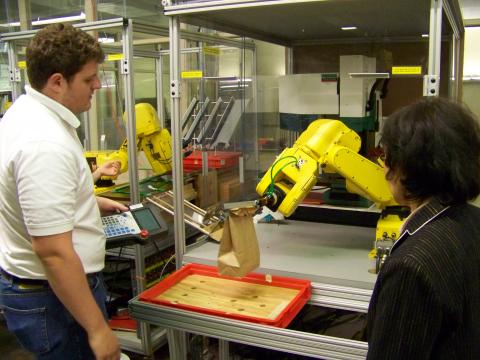
Industrial engineers also deal with the design and workings of the factories that make products. They design the workstations, automation, and robotics for systems all along the supply chain. Industrial engineers are often highly involved in any managerial aspects of modern businesses. These duties range from floor manager all the way up to CEO.

In addition, industrial engineers are concerned with employee safety and workplace environments. They balance the implementation of responsible processes with the other requirements of making a product or providing a service of high quality.

In today's global marketplace, industrial engineering is fast becoming international engineering. Global boundaries are diminishing, requiring industrial engineers to be fluent in foreign languages and customs. International travel could very well be the norm for engineers, as companies expand and conduct more and more business with foreign governments.


Career Education in Industrial Engineering

Due to the fact that career options are nearly limitless for industrial engineering majors, they must get a well-rounded education. This requires the study of:
  • Computer systems
  • Mathematics
  • Statistics
  • Design
  • Management
In addition, it is wise for the industrial engineering major to focus on the physical and social sciences, including economics.

Industrial Engineering Coursework

Students entering into an industrial engineering degree program should expect to enroll in many of these types of classes:
  • Engineering Economy
  • Manufacturing Processes
  • Operations Research
  • Simulation
  • Industrial Cost Control
  • Robotics and Automation
  • Inventory Control
  • Facility Design
  • Organizational Management
  • Quality Control
  • Human Factors
  • Methods & Work Measurement
  • Production Control

On-Campus and Online Degree Programs in Industrial Engineering

Although some campus and online colleges offer associate degrees in industrial engineering technology, most careers in the field of industrial engineering require a bachelor's degree at minimum. Since the field is so specialized, and since proper training and education are vital to the safety of so many people, a bachelor's degree is usually required for entry-level positions. Online degrees are rarely available at this level, since so much hands-on training is required.

A bachelor's degree generally takes four years to complete. Courses typically include core engineering classes available to all disciplines in addition to specialized industrial engineering classes.

What Can You Do With a College Major in Industrial Engineering?

Industrial engineers determine the most effective way to use the basics of any production - people, machines, materials, information, money, and energy - in order to make a product or provide a service. Some of the most productive and successful professionals in the industrial engineering field share many of these common traits:
  • Oral and written communication skills
  • Organizational ability
  • Computer literacy
  • Creativity
  • A knack for designing and improving systems
  • Mathematics ability
  • Problem solving
  • People skills
The industrial engineer provides the key to achieving the performance goals of ownership or management. Unlike engineers in other specialties, the industrial engineer is primarily concerned with increasing productivity through the management of people, the methods of organization and the available technology.

In order to solve problems encountered in product manufacturing and service industries, industrial engineers must study the product and its requirements. They use mathematical models to figure out production requirements and to design manufacturing and information systems. They develop and manage systems that aid in financial planning for individual products. This is also an effective method of cost analysis.

Industrial engineers design financial systems and improve, upgrade, and reconfigure these systems. Those engineers on the management track may also develop wage, payroll, and salary administration systems and other job performance and evaluation systems. These engineers are so deeply involved with every nuance of the corporate system that they are often the best source for overall company evaluation.

Health and safety engineers are very similar to industrial engineers. They both deal with the entirety of a production process. Health and safety engineers promote worksite safety and corporate health by applying models and systems of the industrial process. These engineers must be able to recognize and then diffuse hazardous situations before they come to pass.

In addition to manufacturing and service industries, industrial engineers apply their knowledge to a variety of industries and positions. An industrial engineering major might work as a:
  • Management Engineer: The management engineer is primarily responsible for the systems and procedures that make employees more effective, individually and as a unit.
  • Ergonomist: An industrial engineer who is concerned with the proper tool usage and health systems that prevent stress and injury.
  • Operations Analyst: Responsible for integrating people and machines effectively and safely.
  • Quality Engineer: Measures, tests and ensures the quality and safety of products or services.
Industrial engineering graduates might find themselves working on projects like these:
  • Designing the admissions procedure at a hospital.
  • Discovering a new way to assemble a product that will prevent worker injury.
  • Representing a company in the design and construction of a new plant.
  • Performing motion and time studies.
  • Developing prototype units for the cellular phone car adapter market.
  • Simulation modeling.
  • Developing a hardware protection program for spacecraft.
  • Developing a supplier quality program.
  • Implementing lean manufacturing concepts.
  • Developing and launching a complete material handling system.
  • Developing the conceptual layout of a dockyard and ship repair facility.
  • Working on a medical device to treat sleep apnea.
  • Representing manufacturing and purchasing concerns on a design team.
  • Teaching industrial engineering courses.
  • These are just a few areas in which businesses use industrial engineers. In essence, when a company functions at the highest level of productivity, an industrial engineer probably designed and implemented the systems that brought the company to that point.

Certification, Licensure and Associations

No national licensing body certifies industrial engineers. Most employers rely on the solid training that graduates receive during their degree programs. Instead, most licensing and certification is reserved for the products designed and developed by industrial engineers.
Since an industrial engineer can effectively function in any field, s/he must conform to the certification bodies that oversee his or her particular specialty. Some states do require additional licensing as an engineer. Consult your local statute and licensing boards for more information.
 

Pursue your Industrial Engineering Major today…

Saturday, 26 September 2015

Choosing MANUFACTURING ENGINEEERING


What is Manufacturing Engineering?


More than the average person might realize, engineers are creative pillars of modern society. While a painter focuses his creative energy towards expressing himself on a canvas, a manufacturing engineer works on the creation of things, processes, and technology. We rely on the vision and genius of our society's engineers every single time we turn on the television, drive a car, check our email, do laundry, or take showers. Basically, the work of an engineer is involved with almost everything we do.

Manufacturing engineers have the task of making manufacturing processes better, faster, and cheaper. Their success or failure directly impacts the advancement of technology and the spread of innovation. A professional in this field constantly reviews the allocation of resources, analyzes productivity, and seeks ways to maximize production while minimizing cost. Manufacturing engineering careers offer challenging opportunities that never fail to engage intellectual curiosity and push the edge of innovative thinking.

As the demands of the American consumer continue to increase, manufacturing engineers will work to develop products, buildings, systems, and various other human necessities. The U.S. Department of Labor predicts that job opportunities for manufacturing engineers will continue to grow over the next decade-albeit more slowly than other industries, due in part to outsourcing. But as companies strive to update production and processes to keep pace with the speed and efficiency of modern technology, the skill sets and knowledge of educated manufacturing engineers will be in increasing demand.

Is Manufacturing Engineering the Right Choice for You?

To achieve success in manufacturing engineering, a quality education is an absolute must. Engineers draw heavily on mathematical and scientific knowledge, and these are skills best developed in a manufacturing engineering degree program. A good engineering degree program will provide students with an opportunity to fuse math and science with top-notch communications skills. But how can you decide if manufacturing engineering is the right field to pursue? There are several things to consider.

First, think about the scope of your engineering interests. Manufacturing engineering is just one facet of the engineering industry. Manufacturing engineers enjoy improving the production process from start to finish. They have the ability to keep the whole production process in mind as they zero in on a particular portion of the process. Successful students in manufacturing engineering degree programs are inspired by the notion of starting with a natural resource, such as a block of wood, and ending with a usable, valuable product, such as a desk.

Secondly, earning a college degree in manufacturing engineering involves intense and thorough study of advanced math and science, including calculus, computer science, physics, and other upper-level courses. Potential students should thrive in such courses. Proper preparation for an engineering education includes high school courses in math, science, computers, and computer assisted drafting.

Compare and contrast different manufacturing engineering programs to find the best fit. This is a good way to discover what qualities you're seeking in a program. Additionally, this type of research will help you figure out what questions to ask admissions counselors. The more information you can gather about a potential manufacturing engineering degree program, the better informed your decision will be.

It is also a good idea for prospective students to talk to an experienced manufacturing engineer. Ask questions about day-to-day job tasks, opportunities for career advancement, education requirements, and anything else you would want to know about your future career. This sort of career investigation will certainly provide a more complete picture of your future opportunities.

Manufacturing Engineering Degree Programs

Even within this highly specialized field of engineering, many choices exist. Whether you're a student interested in developing an initial set of engineering skills, or a professional engineer hoping to focus your general knowledge of manufacturing engineering, you'll enjoy plenty of appealing opportunities.


Online Degrees in Manufacturing Engineering

Recently, the options for studying manufacturing engineering have expanded to include distance learning. Online engineering degree programs enable more students to obtain a quality education without having to relocate to a physical campus. Online degrees have opened the doors to many future engineers, as well as professional engineers hoping to advance their existing careers. An engineering degree can open doors to many other related careers, including information systems management, computer programming, and business consulting.

Because the field advances quickly to keep pace with cutting-edge technology, many manufacturing engineers rely on distance learning to continually increase and improve their skills. Online education makes it possible for students to maintain commitments to full-time jobs while completing requirements to earn a degree. Online engineering students participate in online tutorials, web seminars, and interactive labs virtually. Students who enroll in distance learning degree programs enjoy a unique opportunity to tailor their own schedule and course load to fit in with existing commitments to jobs and family.

Certificate Programs in Manufacturing Engineering

Engineering certificate programs are a worthwhile option, both for new students seeking an introductory educational experience and for current manufacturing engineering professionals who want a more in-depth knowledge of their specialty. Online engineering certificate programs encourage students to improve their skills in a narrow, specific aspect of the field.

This allows manufacturing engineering majors to develop a focused expertise that could translate into stronger employment opportunities and job growth. In addition, when you complete the requirements for a certificate in engineering, many online degree programs allow you to transfer these credits toward a degree program. Certificate programs vary, and potential students should discuss particular degree programs with school admissions counselors.

Associate Degrees in Manufacturing Engineering

Engineering students pursuing an associate degree will discover opportunities in several engineering fields. Most associate's degree programs provide students with foundational knowledge of engineering technology -- a more vocationally-oriented specialization. Students who earn an associate's degree can qualify for many entry-level jobs in engineering technology fields. This is an attractive opportunity for students to get their feet wet in the classroom and on the job before deciding to pursue a more intense degree program.

Bachelor of Science in Engineering

The Bachelor of Science in Engineering is the foundation for the majority of manufacturing engineering careers. Most BSE programs focus heavily on the general concepts of engineering, math, science, and technology. Intense and rigorous, BS programs also emphasize the combination of strong engineering skills with the ability to effectively communicate. Students pursuing a BS in Engineering should also expect to study humanities, history, and ethics.

Co-ops, Apprenticeships and Internships

Students in manufacturing engineering degree programs enjoy several potential career paths. One helpful way to narrow down the options is to participate in engineering-related cooperative education programs (co-ops) and internships.

Because engineering involves applying science, math, and technology to real-world problems, engineering professionals find hands-on experience a critical part of a quality education. Students have the opportunity to gain solid work experience as interns and co-op associates, and manufacturing companies are able to find bright, motivated young engineers early in their careers.

The process of landing a summer internship or a semester-long co-op is very competitive, but this should be a priority for any manufacturing engineering student who isn't already in the industry. Major manufacturing companies offer internships to students who excel academically, demonstrate leadership potential, are willing to work hard, and have the ability to communicate effectively. It is not uncommon for a student to intern at the same company for multiple summers, and it is also not uncommon for companies to offer full-time employment to outstanding interns and co-op participants upon graduation.

What Can You Do With a College Major in Manufacturing Engineering?

  • Industrial Engineer. Industrial engineering often overlaps with manufacturing engineering. With a similar focus on manufacturing processes, industrial engineers focus on the product development process and seek to constantly streamline and improve manufacturing techniques. Professionals working in this field often pursue advanced training in quality assurance and operations management. Industrial engineers find work in several industries, including manufacturing, technology, and service. As modern technology continues to advance, industrial engineers are applying manufacturing techniques to most other industries.
  • Business Consultant. When a manufacturing company is having trouble addressing problems, they often hire a business consultant to offer advice and potential solutions. Successful engineering consultants are experts in particular niches or industries. Business consultants are able to look at problems objectively, formulate plans for improvement, and most importantly, effectively communicate with clients. Business consultants with degrees in manufacturing engineering are especially valuable to companies seeking to update and streamline production and assembly procedures. Knowledge of proven business and management principles is necessary for this career.
  • Operations Research Analyst. An operations research analyst studies processing and manufacturing procedures in order to determine areas for improvement and growth. Professionals in this field rely on extensive research and observation to make decisions and solve problems. Like a manufacturing engineer, operations research analysts are able to view the bigger picture of a production process in order to gauge how to make the individual components of the process cheaper and more efficient. Operations research analysts focus on the end result and continually try to improve their products. This type of position is found in various parts of the engineering industry, including manufacturing engineering and industrial engineering.
  • Engineering Technician. Engineering technicians apply scientific, mathematic, and engineering theories and methods to solve technical problems in various fields of engineering. Most engineering technician jobs require an associate degree. Engineering technicians in the manufacturing industry generally assist more experienced engineering professionals in research, product design, manufacturing procedures and various related tasks. The function of an engineering technician generally involves practical and physical assignments, like using an engineer's plan to build a prototype of a product or utilizing computer assisted drafting tools to generate virtual models.
  • Engineering Managers. Engineering managers are experienced engineering professionals who are successfully able to combine their command of engineering technique and theory with excellent communication skills. In general, an engineering manager guides, oversees, and directs teams of engineers and is responsible for the productivity and results of her team. Many engineering managers work in the manufacturing industry, and a background in manufacturing engineering is a solid foundation for future engineers hoping to pursue this advanced career path.
  • Information Systems Managers. Systems managers develop, modify, and monitor information systems, which collect and track data and enable users to recall and pull up information quickly. Information systems managers have to keep up with constantly changing computer technology and create plans to implement the latest technology on existing systems. In addition, they supervise teams of computer programmers, computer engineers and systems analysts. Information systems managers rely on their manufacturing engineering degrees constantly, in order to appropriately address the requirements of managing information systems.


Powered by Blogger.